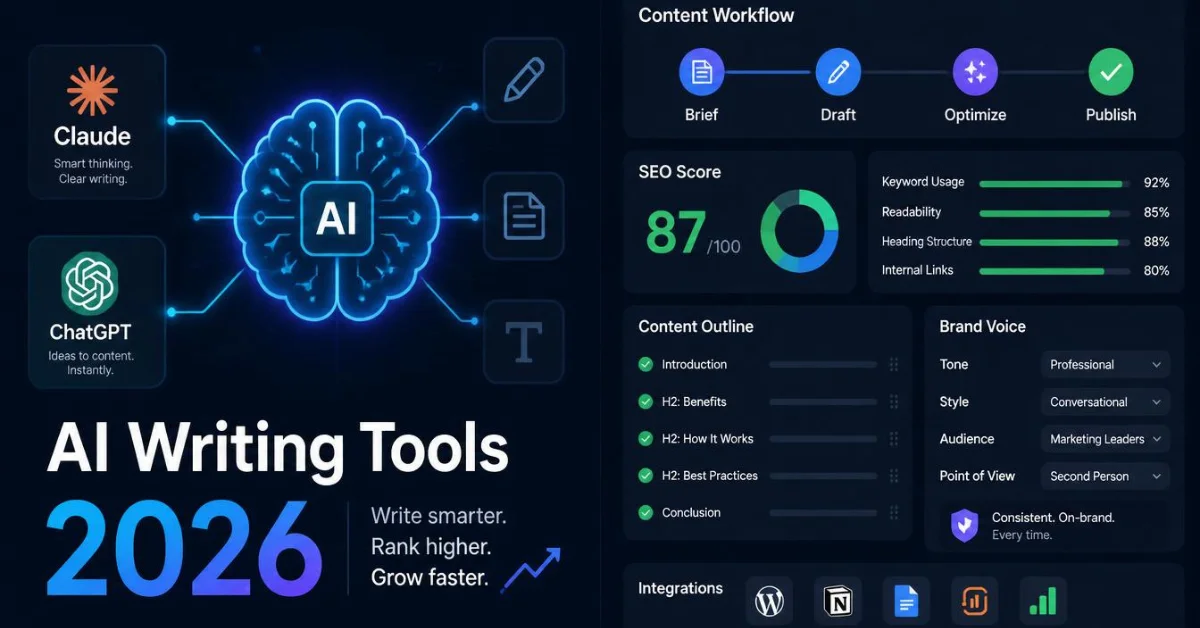
If you’ve used the same AI writing tool for the past year without checking what’s new, you’re probably leaving either quality or money on the table. 2026 has split the market into two clear lanes: general-purpose models that write better with less editing, and SEO/marketing platforms that have leaned hard into automation and brand control.
This isn’t another “top 10 AI writing tools” roundup. It’s a breakdown of what specifically changed this year, what it costs now, and whether the upgrade is worth it for your kind of writing.
The Real Shift: Quality vs. Workflow
The biggest change in 2026 isn’t one feature — it’s that the line between “writing tool” and “content operations platform” has finally become clear.
Writing quality tools — Claude, ChatGPT — compete on how little editing their output needs and how naturally it holds tone across a full piece.
Workflow tools — Jasper, Copy.ai, Grammarly Business — compete on managing content at scale: brand voice across a 12-person team, SEO data pulled in automatically, multi-channel campaigns generated from one brief.
A solo blogger doesn’t need Jasper’s campaign builder. A marketing team running five brand voices across three clients doesn’t need a model that’s slightly better at metaphors. Picking based on which category you’re actually in saves both money and frustration.
Claude and ChatGPT: The General-Purpose Race
Claude has had several model releases through 2026 — Sonnet 4.6, Opus 4.7, and Opus 4.8 among them. For everyday writing, Sonnet 4.6 is the one creators consistently point to: it’s the default a lot of writers reach for because the output needs less cleanup before it sounds like a person wrote it. Opus 4.8 is more capable overall, but it’s built for complex reasoning and long agentic tasks — overkill if you’re just drafting a blog post. Claude’s free tier is genuinely usable for drafting; Pro at $20/month unlocks the full lineup. If you’re new to how these models actually work, our plain-language AI explainer covers the basics first.
ChatGPT kept improving GPT-4o through late 2025 into 2026, mostly around handling longer context — useful if you’re feeding it full chapters instead of short prompts. The honest catch: ChatGPT’s default style still has tells. The em-dash habit, the “Certainly!” openers, the bullet-point reflex. 2026 updates toned this down, but it still takes deliberate prompting to avoid the “obviously AI” sound. Claude has fewer of these tells out of the box, which is the actual reason it keeps winning writing-quality comparisons on Reddit and X — not hype, just less post-editing required.
ChatGPT Plus is still $20/month, and if you want one tool that handles writing plus research, brainstorming, and formatting in the same window, it’s still hard to beat at that price.
Jasper: Campaigns Got Real, Pricing Stayed Steep
Jasper’s headline 2026 feature is Campaign mode — you write one brief (audience, key messages, tone, goals) and it generates a matched set of assets: blog post, social captions, email sequence, ad copy, landing page copy, all in the same voice. For an agency juggling five clients, this cuts the brief-and-reformat cycle dramatically.
The brand voice system also got sharper — upload a style guide or paste existing content, and Jasper mimics it across every output. Agencies can store separate voices per client instead of resetting prompts each time.
Pricing: Creator is $39/month annual, Pro is $59/month annual (or $69 month-to-month), and Business is custom — realistically starting somewhere between $250 and $900+/month depending on seats and usage. There’s no permanent free tier, just a 7-day trial on Creator and Pro. That trial is your only real test drive before paying.
Jasper’s actual edge is the native Surfer SEO integration — writing with real-time SEO scoring running alongside the draft is faster than writing in ChatGPT and optimizing separately. But that only pays off if you’re producing enough content to justify stacking two subscriptions worth of cost into one workflow.
Copy.ai: Less “Writing Tool,” More Automation Engine
Copy.ai has quietly repositioned itself as a workflow automation platform rather than a writing assistant. Its multi-step builder — chain actions like research → draft → rewrite-for-social → schedule — is noticeably more reliable in 2026, and the HubSpot/Zapier/Salesforce integrations work better than they did a couple of years ago.
Pricing: Pro is $49/month, or $36/month billed annually. The free plan gives 2,000 words/month and 90+ templates, but strips out Brand Voice and Infobase — the two features that actually make Copy.ai’s output feel less generic.
What hasn’t changed: there’s still no built-in SEO research. Stack on Frase ($15/month) or Surfer ($89/month) and the total cost lands close to what Jasper charges with SEO built in. Where Copy.ai genuinely wins is short-form output at volume — ad variations, subject lines, product descriptions — fast, usable, and not trying to be a blog-writing tool pretending otherwise.
Surfer SEO: Pricier, But Still the Benchmark
Surfer’s core mechanic hasn’t changed — it scores your draft against top-ranking pages for word count, headings, keyword density, and semantic coverage. What changed is the price: it’s now $89/month, a real jump from where it sat a few years back.
Whether that’s worth it depends on your site. If you’ve already got domain authority and a publishing cadence, Surfer’s scores correlate well with what actually ranks. If you’re a newer site, technical on-page optimization matters less than link equity and topical depth right now — so $89/month is a harder sell early on. Frase at $15/month covers the fundamentals if Surfer’s price is the blocker.
The Bigger Problem: AI Overviews Changed What “Good Content” Means
If you’re on WordPress, pairing your AI workflow with the right SEO plugin setup matters just as much as which writing tool you pick.
This is the part most roundups skip. Google’s AI Overviews and the broader spread of answer engines mean content now has to work on two surfaces at once — the traditional blue-link result, and the AI-generated summary sitting above it. Google has been explicit that it rewards content demonstrating original value and expertise, regardless of how it was produced — which is exactly why thin, unedited AI drafts are struggling now.
Practically: publishing a first-draft AI output with light editing performs worse in 2026 than it did two years ago. Google’s systems have gotten noticeably better at flagging thin, templated AI content. What’s still ranking well in AI Overviews tends to share three things — first-person experience signals, specific factual detail, and editorial judgment that a fully automated draft doesn’t generate on its own.
The writers getting real results aren’t avoiding AI — they’re using it for structure, research summaries, and the repetitive formatting work, then adding the specificity and voice themselves. That division of labor is the actual skill in 2026, not which subscription you pick.
Grammarly and Notion AI: The Quiet Upgrades
Grammarly has moved well past grammar checking. The 2026 version adds tone detection (flags when a draft reads more formal or casual than intended), a full rewrite mode, and — on Business plans — brand voice checking against a style guide. Premium is $30/month (or $12/month billed annually), making it one of the cheaper ways to clean up AI-generated drafts rather than generate them from scratch. Running Jasper or ChatGPT output through Grammarly’s rewrite suggestions genuinely produces less templated prose than the raw output.
Notion AI 3.0, launched early 2026, added document summarization, meeting note generation, and an in-page writing assistant. If your team already lives in Notion for project management — and you’re weighing it against alternatives, see our Notion vs Obsidian comparison — Notion AI is included in Notion Plus at $10/month per user, no separate subscription needed.
So Which One Should You Actually Use?
- Solo blogger / content creator: Claude or ChatGPT Plus ($20/month) for the writing, plus Frase ($15/month) or Surfer ($89/month) if SEO is the goal.
- Marketing team running multi-channel campaigns: Jasper Pro ($59/month) — the Campaign tools and Surfer integration earn their cost here.
- High-volume short-form copy (ads, emails, social): Copy.ai Pro ($36/month annual) is the clearest value for this specific job.
- You just need cleaner editing, not generation: Grammarly Premium ($12/month annual) does that one job well.
FAQ
Which AI writing tool is best in 2026?
For raw writing quality with the least editing, Claude Sonnet 4.6 is the consistent pick. For brand voice and campaign workflows, Jasper Pro. For short-form copy at volume, Copy.ai Pro. There’s no universal winner — it depends on what you’re producing and how much of it.
What happened to AI content and SEO in 2026?
Google’s AI Overviews raised the bar. Fully automated drafts with no human input are ranking worse than they did in 2024. Tools that pair AI speed with human editorial judgment — and SEO layers like Surfer or Frase — matter more now, not less.
Is Jasper worth it in 2026?
If you’re producing 20+ pieces a month for a brand with specific tone requirements and multiple people involved, yes — the workflow features justify the cost. For solo or low-volume use, Claude or ChatGPT at $20/month covers most of the same ground for a fraction of the price.
What’s the best free AI writing tool in 2026?
Claude’s free tier produces stronger long-form prose than ChatGPT’s free tier. Copy.ai’s free plan (2,000 words/month, 90+ templates) is decent for short-form testing. For SEO specifically, there’s no strong free option — Frase at $15/month is the cheapest real entry point.
Has ChatGPT actually gotten better at writing in 2026?
Yes — better coherence on long rewrites, better handling of extended context. But the recognizable AI patterns (em dashes, “Certainly,” heavy bullet use) are still there by default and need active prompting to avoid. Claude has fewer of these tells out of the box.
Jasper vs. Copy.ai — what’s the real difference?
Jasper wins on long-form, brand-governed content and native SEO integration. Copy.ai wins on short-form volume and flexible workflow automation. Similar price tier, different strengths.
Do I need a paid tool, or is free enough?
For occasional use, free tiers (Claude, ChatGPT) cover most needs. For regular content production with SEO goals, the realistic minimum stack is one paid writing tool ($20/month) plus one basic SEO tool ($15/month) — about $35/month total.