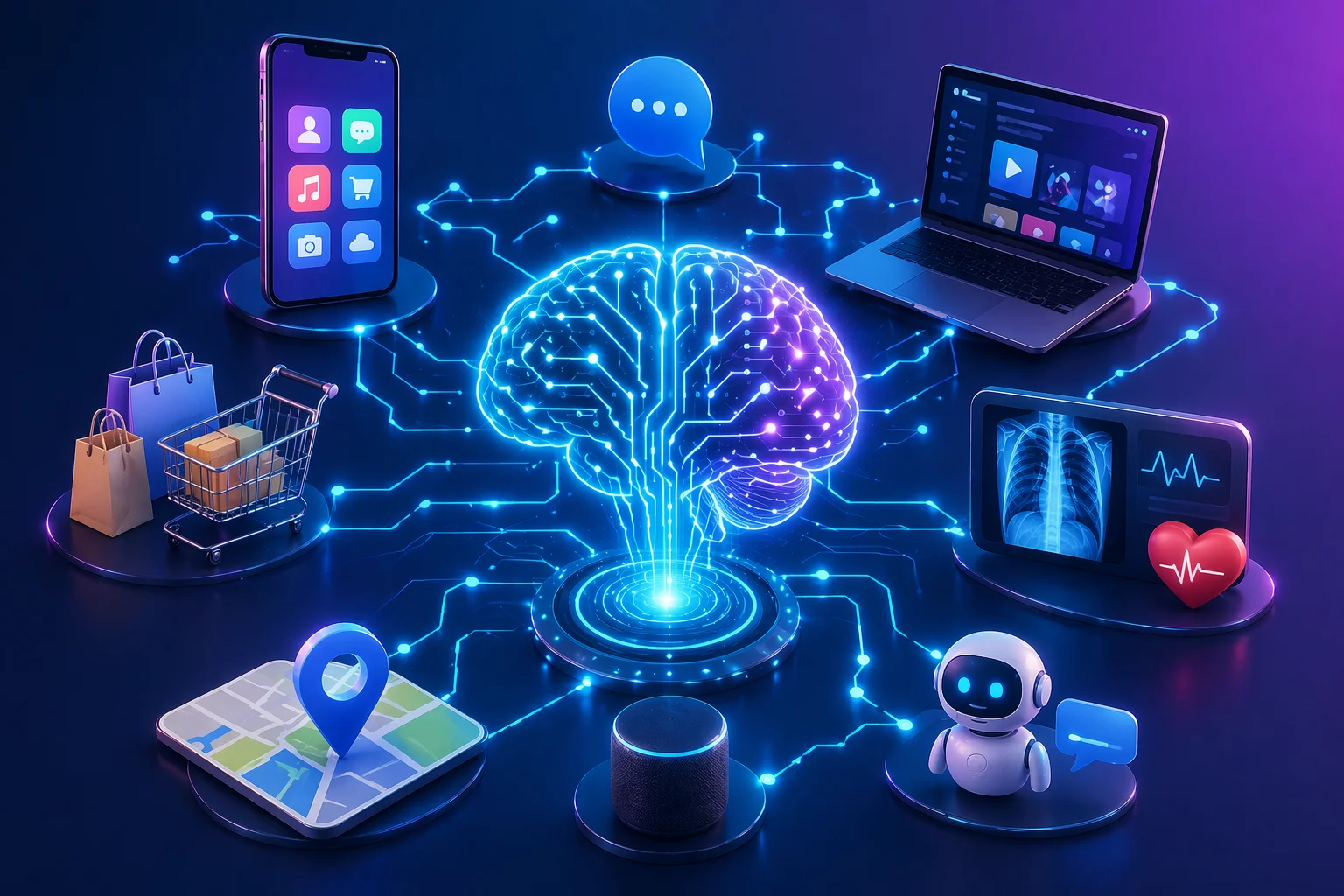
Quick Answer: Artificial intelligence explained simply: it’s technology that learns patterns from data and uses them to make predictions or decisions, rather than following a fixed set of programmed instructions. In 2026 it has moved well past novelty status — ChatGPT alone has more than 900 million weekly active users, and roughly half of US adults now say they use an AI chatbot, with about a quarter using one daily.
Artificial intelligence is no longer something from science fiction — it quietly powers many of the tools you use every day. From the moment you unlock your phone with your face to the route your maps app suggests on the drive to work, AI is working behind the scenes far more often than most people realize.
What Is Artificial Intelligence?
Artificial intelligence is a branch of computer science focused on building systems that can perform tasks that normally require human intelligence — understanding language, recognizing images, learning from data, and making decisions. Instead of following fixed instructions written by a programmer for every possible situation, AI systems learn patterns from large amounts of data and improve their performance as they’re exposed to more of it. That distinction is what separates AI from traditional software: a calculator app follows the same fixed rule every time, while an AI spam filter adjusts what it flags as junk based on millions of examples of real and fake emails it has already seen.
How AI Actually Works
AI works by combining three elements that build on each other. The first is data — AI needs examples to learn from, whether that’s text, images, video, or numbers. A face-recognition system, for instance, is trained on thousands of labeled photos before it can reliably identify a face in a new one. The second is algorithms, the step-by-step mathematical instructions that tell the system how to search through that data for patterns and relationships. The third is the learning model itself, most commonly machine learning or deep learning. Machine learning is the broader category — systems that improve automatically as they process more data rather than being manually reprogrammed. Deep learning is a more specialized approach within machine learning that uses layered neural networks loosely modeled on how neurons connect in the human brain, and it’s the technique behind most of the large language models and image generators people interact with today. Together, these three pieces let a system take in new information and produce a prediction, a classification, or a generated response — which is what’s actually happening every time you type a question into a chatbot and get an answer back in seconds.
Types of Artificial Intelligence
AI is generally grouped into three categories based on how broadly a system can apply its intelligence, and the gap between what exists today and what’s still theoretical is much wider than most headlines suggest.
| Type | What It Can Do | Current Status |
|---|---|---|
| Narrow AI (Weak AI) | Performs one specific task well — language, image recognition, recommendations | Everything in use today, including ChatGPT, Siri, and Netflix recommendations |
| General AI (Strong AI) | Would match human-level reasoning across any intellectual task | Does not exist; a major, unresolved research goal |
| Super AI | Would exceed human intelligence across all domains | Purely theoretical, not close to realization |
Narrow AI is the only category that actually exists in 2026, no matter how fluent or capable a chatbot response sounds. Every AI product currently on the market — including the most advanced language models — is still performing narrow, task-specific pattern matching rather than general reasoning the way a human does across unrelated domains.
Real-Life Examples of AI in 2026
AI’s presence in daily life has grown fast enough that the scale is worth putting in concrete numbers rather than vague description. As of February 2026, OpenAI reported more than 900 million weekly active users for ChatGPT, and by June 2026 the ChatGPT app had crossed 1 billion monthly active users — according to Sensor Tower estimates reported by Reuters, making it the fastest consumer app in history to reach that scale. Pew Research Center’s June 2026 survey of US adults found that 49% now report using an AI chatbot, up from 33% in 2024 and just 23% in 2023, with 24% using one on a daily basis. On smartphones, AI handles face recognition for unlocking, powers voice assistants like Siri and Google Assistant, and processes photos in real time to improve low-light shots or blur backgrounds. In online shopping, AI analyzes past behavior to generate “you may also like” recommendations, a system that retailers have refined enough that a meaningful share of e-commerce revenue now comes directly from AI-driven suggestions. Social media platforms use AI to decide what content appears in a feed by analyzing likes, shares, and watch time down to the second. Navigation apps like Google Maps use AI to predict traffic conditions, suggest faster routes, and estimate arrival times based on real-time data from other drivers on the same roads. In healthcare, AI assists doctors by detecting patterns in medical scans, flagging anomalies for review, and helping prioritize which patient records need closer attention. In banking and finance, AI drives fraud detection systems that flag unusual transaction patterns within seconds, informs credit scoring models, and increasingly powers algorithmic trading systems. Businesses evaluating whether these tools are worth adopting for their own operations can start with a narrower, practical look at how AI visibility and monitoring tools are used to track brand presence across AI-driven search results, which is one of the newer categories built entirely around this shift.
How AI Learns Over Time
AI improves through a process called training, and it follows a consistent cycle regardless of the specific application. The system is first given a large volume of data. It then makes predictions or decisions based on what it’s seen so far. Those outputs are compared against known correct answers, and the errors are measured mathematically. The system adjusts its internal parameters to reduce those errors, and the entire cycle repeats — often millions of times — until performance stabilizes at an acceptable level. This is why AI systems generally need substantial amounts of data and computing power before they become useful: a model trained on a small, narrow dataset will make confident-sounding but frequently wrong predictions, since it hasn’t seen enough variation to generalize reliably.
Benefits of AI in Real Life
The practical case for AI adoption comes down to a handful of measurable advantages. It saves time by automating repetitive tasks that would otherwise consume hours of manual work — analyzing thousands of records in seconds rather than the hours or days a person would need. It reduces certain categories of human error, particularly in tasks involving large volumes of repetitive data entry or pattern matching. It can improve decision-making by surfacing patterns in data that would be difficult for a person to spot manually, and it handles large datasets efficiently in ways that scale far better than adding more staff. For small businesses specifically, this often shows up first in lower-cost access to capabilities that used to require dedicated specialists — a shift covered in more detail in our guide to cloud computing for small business, since most AI tools today are delivered as cloud services rather than software installed locally.
Limitations of AI
AI’s limitations are just as concrete as its benefits, and they matter more the more a business or individual relies on it. Performance depends heavily on data quality — a model trained on biased, incomplete, or unrepresentative data will produce biased or unreliable outputs, and this bias can be difficult to detect until it shows up in a real-world decision that affects someone unfairly. AI systems lack genuine understanding, emotion, or judgment; they generate statistically likely outputs based on patterns in training data, which is different from reasoning through a novel situation the way a person would. Training and running large AI models requires significant computing power and energy, which is part of why data center electricity demand has become a growing concern for utilities and regulators. AI also raises real privacy concerns, since many systems are trained on or process large volumes of personal data, and it’s not always transparent to users how that data is stored, used, or protected. None of this makes AI unusable — it means treating AI output as a draft or a starting point that still needs human review, rather than as a final, unquestionable answer.
Where AI Is Headed Next
The areas seeing the most active investment going into the rest of 2026 include self-driving vehicle systems, AI-assisted urban infrastructure and traffic management, personalized education tools that adapt to an individual student’s pace, and expanded diagnostic support in healthcare. At the same time, enterprise adoption has moved past experimentation — a large majority of Fortune 500 companies now report using ChatGPT or a similar tool somewhere in their operations, and OpenAI alone reports more than 9 million paying business users. That kind of scale is also why regulatory attention has intensified alongside adoption, with governments in the US, EU, and elsewhere actively working through rules for data use, transparency, and accountability in AI systems rather than leaving the technology to develop entirely unregulated.
Frequently Asked Questions
Is AI the same as machine learning?
No. Artificial intelligence is the broader field — any system designed to perform tasks that normally require human intelligence. Machine learning is one specific approach within AI, where systems improve automatically by learning from data rather than following manually programmed rules. Deep learning is, in turn, a specialized subset of machine learning that uses layered neural networks. All machine learning is AI, but not all AI uses machine learning.
Does AI actually think like a human?
No. Current AI systems, including advanced language models, perform statistical pattern matching based on training data rather than genuine reasoning or understanding. A chatbot can produce a fluent, confident-sounding answer without any real comprehension of what it’s saying, which is why AI output can sound authoritative while still being factually wrong — a known limitation often called hallucination.
How many people actually use AI tools in 2026?
According to Pew Research Center’s June 2026 survey of US adults, 49% now report using an AI chatbot, up from 33% in 2024 and 23% in 2023, with 24% using one daily. Globally, ChatGPT alone reported more than 900 million weekly active users as of February 2026 and crossed 1 billion monthly active users by June 2026.
Can AI make mistakes or be wrong?
Yes, regularly. AI systems generate outputs based on patterns in their training data, and when a question falls outside what the system has reliably learned, it can produce a plausible-sounding but incorrect answer with the same confident tone as a correct one. This is a well-documented limitation across every major AI model currently available, which is why human review remains important for anything consequential.
Is General AI (human-level AI) close to being real?
No. Every AI system in commercial use today, including the most advanced language models, is Narrow AI — designed and trained for specific tasks rather than general reasoning across unrelated domains. General AI, which would match human-level intellectual flexibility, remains an active research goal without a confirmed timeline, despite frequent speculation in the media.
What industries use AI the most right now?
Technology, finance, healthcare, and retail show the heaviest current AI adoption. In finance, AI powers fraud detection and credit scoring. In healthcare, it assists with diagnostic imaging review. In retail, it drives personalized recommendations. Enterprise-wide, more than 9 million paying business users now rely on ChatGPT specifically, and a large majority of Fortune 500 companies report using it somewhere in their operations.
Do I need technical skills to use AI tools?
No. Most consumer-facing AI tools — chatbots, image generators, voice assistants — are designed for plain-language use with no coding or technical background required. Building or customizing AI systems for a business does require technical expertise, but using the tools that already exist generally does not.