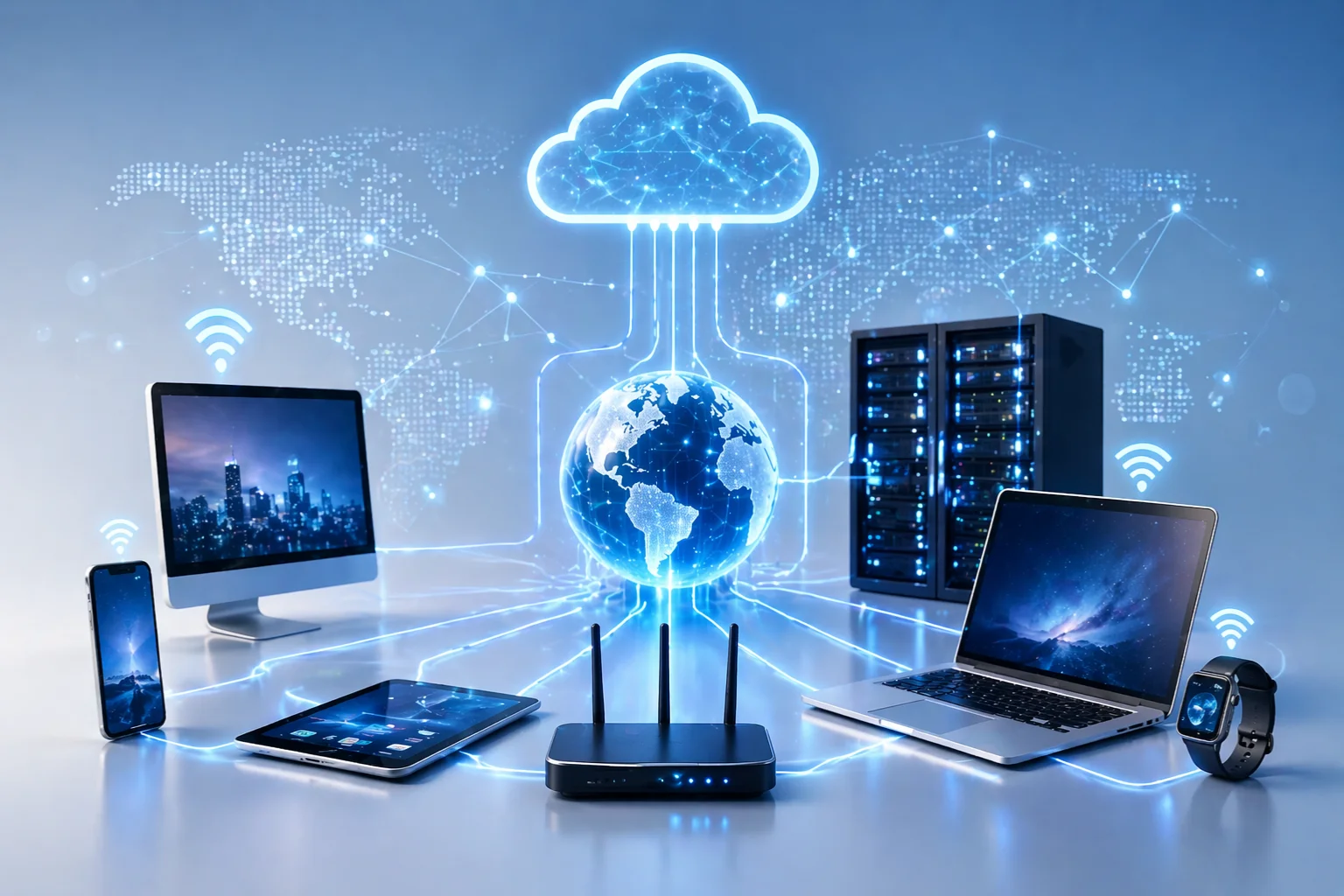
Quick Answer: Technology is the application of knowledge, tools, and systems to solve problems and make tasks easier — ranging from simple tools like a wheel to complex systems like artificial intelligence. In 2026, technology is defined less by individual devices and more by how AI, cloud computing, and connected systems work together: there are now roughly 21.9 billion connected IoT devices worldwide, and the average cost of a data breach has climbed to a record $4.99 million globally.
Technology is everywhere around you — often so deeply integrated into daily life that you barely notice it. From the smartphone in your hand to the systems that run hospitals, banks, and transportation, technology shapes how people live, work, and connect. What has changed in the last two years isn’t the definition of technology itself, but the speed at which AI has moved from a specialized field into the default layer underneath nearly every digital tool people use.
What Is Technology?
Technology is the use of knowledge, tools, and systems to solve problems and make tasks easier. The word comes from the Greek words techne, meaning skill or craft, and logos, meaning knowledge. Together they describe the application of knowledge to practical purposes. At its core, technology is about applying human ideas in a practical way. It turns thinking into real-world solutions that improve efficiency, comfort, safety, and productivity. Technology does not have to be digital or electronic — a pencil, a pair of scissors, and a wooden bridge are all forms of technology. A simple way to understand technology: if a human created it to solve a problem or make a task easier, it is technology. A wheel helps move heavy objects easily. A calculator performs quick mathematical operations. A smartphone connects people across the world instantly. A water pump delivers clean water to a village. Each of these is a form of technology designed to address a specific human need — the difference between 2026 and a decade ago is that most of these tools now talk to each other and adjust their own behavior based on data, rather than staying static once built.
Types of Technology, Compared
Technology is a broad field with several distinct categories. Each type serves a different purpose, and most modern products — a hospital, a car, a factory — combine several of them at once rather than relying on just one.
| Type | What It Covers | Common Examples |
|---|---|---|
| Information Technology | Managing, processing, and sharing data | Cloud storage, business software, databases, servers |
| Communication Technology | Sharing information between people | Smartphones, messaging apps, video calls, social media |
| Medical Technology | Diagnosing, treating, and monitoring patients | MRI machines, surgical robots, wearable monitors, telemedicine |
| Industrial Technology | Manufacturing and production | Assembly-line robotics, automation software, 3D printing |
| Transportation Technology | Moving people and goods | GPS navigation, electric vehicles, autonomous driving systems |
| Energy Technology | Producing, storing, and distributing power | Solar panels, wind turbines, battery storage, smart grids |
Information Technology
Information technology includes computers, software, and networks used to manage, process, and share information. IT is the backbone of modern businesses, schools, and governments. Almost every organization today depends on IT systems to operate — laptops and servers for processing data, cloud storage systems for saving and accessing files remotely, business management software for tracking operations, and databases for storing large amounts of information.
Communication Technology
Communication technology focuses on sharing information between people and organizations. It has transformed how humans interact — making instant global communication possible. Mobile phones and smartphones, email and messaging applications, video calling platforms, and social media have all compressed distance in ways that were impossible a generation ago.
Medical Technology
Medical technology includes tools, devices, and systems used in healthcare to diagnose, treat, and monitor patients. Advances in medical technology have dramatically increased life expectancy worldwide. MRI and CT scan machines, robotic surgical systems, wearable health monitors, and telemedicine platforms have moved care from reactive to preventive in ways that continue to accelerate.
Industrial Technology
Industrial technology is used in manufacturing and production to increase output, improve quality, and reduce costs. Factory machines and assembly lines, robotics systems for precision manufacturing, automation software, and 3D printing form the foundation of modern supply chains and economies.
Transportation Technology
Transportation technology helps move people and goods efficiently across short and long distances. Cars, trains, ships, and airplanes enabled modern global trade. GPS navigation, electric vehicles, and autonomous driving technology are reshaping how transportation works at every scale.
Energy Technology
Energy technology covers the production, distribution, and storage of energy. Solar panels, wind turbines, battery storage systems, and smart grid technology are central to the transition away from fossil fuels — one of the most consequential technology shifts of the current era.
How Technology Has Evolved
Technology developed gradually over thousands of years — each era building on the discoveries of the previous one.
Early Technology — Stone Age to Ancient Civilizations
In ancient times, humans used simple tools made from stone, wood, and metal to survive and build communities. Fire for cooking and warmth, stone tools for hunting, the wheel for transportation, and writing systems for recording knowledge — each was revolutionary for its time and laid the foundation for everything that followed.
Industrial Age — 1760s to Early 1900s
The Industrial Revolution transformed economies by replacing manual labor with machine power. Steam engines, textile machines, railways, and telegraph systems moved production from small workshops to large factories, dramatically increased output, and created economic systems that shaped the modern world.
Digital Age — 1950s to 2000s
The invention of the transistor and microchip made computers possible. The development of the internet transformed how people communicate, access information, and conduct business. Personal computers brought computing into homes. Email and websites enabled instant communication and commerce at a global scale.
Modern Era — 2010s to Present
Today technology focuses on intelligence, connectivity, and automation. Artificial intelligence powers voice assistants, product recommendations, and workflow automation. Smartphones have more computing power than early supercomputers. Cloud computing enables access to powerful systems from anywhere. Global IoT connections reached an estimated 21.9 billion in 2026 — up 14% year over year — and are projected to approach 30 billion by 2030 as more industrial sensors, wearables, and smart home devices come online.
Key Components of Technology
Technology is not just about physical devices. It includes several interconnected elements that work together: tools and machines — the physical objects used to perform tasks; software and systems — the programs that control how machines operate; knowledge and skills — the human understanding needed to create and use technology; processes and methods — the steps used to build, test, and deploy technology; and infrastructure — the networks, power systems, and facilities that technology depends on.
Benefits of Technology
Increased Efficiency and Productivity
Tasks that once took days can now be completed in minutes. Automation handles repetitive work, freeing humans to focus on creative and complex tasks. Businesses process thousands of transactions per second that would have been impossible manually. AI tools now write first drafts, generate images, analyze data, and schedule meetings — tasks that collectively consumed significant working hours before automation reached this level. Small businesses evaluating whether to adopt AI tools for these tasks can start with our breakdown of AI productivity tools, which covers what each category actually automates versus what still needs human review.
Better Communication
Technology has eliminated distance as a barrier to communication. People can send messages, make video calls, share files, and collaborate in real time regardless of where they are in the world. Remote work at scale — now standard across knowledge industries — was only possible because communication technology reached the reliability and speed that made distributed teams viable.
Improved Healthcare
Medical technology saves lives every day. Advanced imaging detects diseases earlier. Surgical robots perform procedures with greater precision. Monitoring devices track health conditions in real time. AI-assisted diagnostics are reducing the time between symptom onset and accurate diagnosis in radiology, pathology, and early cancer detection.
Access to Education and Information
The internet has made knowledge accessible to anyone with a connection. Students in remote areas can access world-class educational content. Professionals can learn new skills online. Information that once required visiting a library is now available in seconds — and AI tools have made that information faster to find, summarize, and apply than any previous technology.
Economic Growth and Job Creation
Every major wave of technology has created new industries and employment. The digital economy has generated millions of jobs in software development, data analysis, digital marketing, cybersecurity, and AI — fields that did not exist a generation ago. The U.S. Bureau of Labor Statistics projects continued double-digit employment growth for most technology occupations through the next decade, though the mix of roles within those fields is shifting quickly as AI automates certain entry-level tasks.
Challenges and Risks of Technology
Privacy and Security Risks
Every device connected to the internet is a potential target. Personal data collected by apps and websites can be misused. Cyberattacks cost businesses and individuals billions of dollars every year. According to IBM’s 2026 Cost of a Data Breach Report, the global average cost of a data breach reached a record $4.99 million — a 12% increase from the year before — while breaches at U.S. organizations averaged $11.5 million, more than double the global figure. AI is reshaping this picture on both sides: AI-driven attacks increased 56% year over year and added roughly $1 million to the average cost of a breach, while organizations using AI and automation in their security operations cut breach costs by nearly $2 million on average. Understanding basic digital security is now an essential skill for anyone who uses the internet, not just for IT professionals. For a practical overview of how organizations protect data in cloud environments, see our guide on data security in cloud computing.
Job Displacement from Automation
Automation and artificial intelligence are replacing certain types of work — particularly routine and repetitive tasks. Entry-level software and content roles have seen the sharpest contraction in job postings as AI coding and writing tools automate work that junior employees traditionally handled. While new jobs are created in every technology wave, the transition can be difficult for workers whose skills become obsolete faster than they can retrain. Continuous learning is increasingly a professional survival skill, not just a competitive advantage.
Digital Divide
Not everyone has equal access to technology. Differences in income, geography, and education create a gap where some people benefit from technological advances while others are left behind. As of early 2026, an estimated 2.2 billion people worldwide remain offline, with the majority concentrated in Southern Asia and Sub-Saharan Africa, where infrastructure costs and low household income remain the primary barriers. Bridging this gap remains one of the most important challenges facing governments and organizations working toward universal connectivity goals.
Environmental Impact
Producing and disposing of electronic devices consumes significant energy and creates waste. Global data center electricity consumption reached roughly 485 terawatt-hours in 2025, about 1.5–2% of total global electricity demand, and grew 17% that year alone according to the International Energy Agency — with AI-focused facilities growing even faster. The IEA projects total data center electricity use will roughly double to approach 950 TWh by 2030 as AI training and inference scale up. Developing more sustainable technology practices is a growing priority for both regulatory bodies and major technology companies.
Overdependence
Heavy reliance on technology can reduce human skills and independence. Navigation apps have reduced many people’s ability to orient without GPS. The challenge is using technology as a tool that enhances human capability rather than replacing the underlying judgment and skills that remain valuable when systems fail.
Advanced Technology Concepts
Artificial Intelligence
Artificial intelligence refers to computer systems that can perform tasks normally requiring human intelligence — understanding language, recognizing images, making decisions, learning from experience. AI is now embedded in search engines, streaming recommendations, virtual assistants, fraud detection, and medical diagnostics. In 2026, AI tools have become accessible enough that students use them for writing assistance, teachers use them for lesson planning, and professionals use them to automate entire categories of repetitive work.
Machine Learning
Machine learning is a branch of AI where systems improve automatically through experience rather than being explicitly programmed. By analyzing large datasets, machine learning models identify patterns and make predictions. It powers spam filters, product recommendations, fraud detection, and voice recognition — and increasingly, it powers the AI writing and image generation tools that millions of people use daily.
Internet of Things
The Internet of Things refers to everyday physical devices connected to the internet — collecting and sharing data with each other and with users. Smart home devices, connected cars, industrial sensors, and wearable fitness trackers are all part of the IoT. Global IoT connections reached an estimated 21.9 billion in 2026, growing 14% year over year, with projections putting that figure near 30 billion by 2030.
Cloud Computing
Cloud computing means storing and accessing data and programs over the internet rather than on a local computer. Instead of buying and maintaining physical servers, businesses and individuals can rent computing power and storage on demand. This has made powerful technology accessible to small businesses at low cost — a startup today has access to infrastructure that would have cost millions to build a decade ago.
Cybersecurity
As technology becomes more central to daily life, protecting digital systems has become critically important. Cybersecurity involves protecting computers, networks, and data from unauthorized access, damage, or attacks. It remains one of the fastest-growing fields in technology, and the record-high breach costs reported by IBM in 2026 reflect why organizations continue investing heavily in both defensive tooling and skilled personnel.
How to Use Technology Wisely
Using technology effectively requires balance, awareness, and continuous learning. Protect your personal data and privacy online by using strong passwords and enabling two-factor authentication. Stay updated with essential digital skills — technology literacy is a fundamental modern skill in almost every career. Avoid overdependence by using technology as a tool that augments your judgment rather than replacing it. Be aware of security risks — understanding basic cybersecurity protects both your personal data and your professional reputation. Use technology to improve productivity rather than increase distraction. And stay informed about new developments — technology changes rapidly enough that what was the industry standard 18 months ago may already be obsolete.
Frequently Asked Questions
What is the simplest definition of technology?
Technology is the use of knowledge and tools to solve problems and make tasks easier. It includes everything from simple hand tools to complex computer systems. Any human-made tool or system designed to accomplish a purpose is a form of technology — from a pencil to an AI model.
What are the main types of technology?
The main types include information technology, communication technology, medical technology, industrial technology, transportation technology, and energy technology. Each category addresses different human needs and has its own tools, systems, and applications. Most modern products and services involve multiple types working together — a modern hospital, for example, uses information technology, medical technology, communication technology, and energy technology simultaneously.
How has technology changed daily life?
Technology has transformed virtually every aspect of daily life. Communication is now instant and global. Information is accessible to anyone with internet access. Healthcare can diagnose and treat conditions that were fatal a century ago. Work can be done from anywhere. Most changes have improved quality of life, though challenges like privacy, security, and overdependence require ongoing attention.
What is the difference between science and technology?
Science is the systematic study of the natural world to understand how things work. Technology is the application of scientific knowledge to create tools and systems that solve practical problems. Science asks how and why things work. Technology asks how to use that knowledge to make something useful. The two are deeply interconnected — most modern technology is built on decades of scientific research.
What is artificial intelligence and how does it relate to technology?
Artificial intelligence is a branch of computer science where systems are designed to perform tasks that typically require human intelligence — understanding language, recognizing patterns, making decisions. AI is one of the most significant technological developments of the 21st century and is now embedded in everyday applications from search engines to virtual assistants. In 2026, AI tools are accessible enough that they have become standard working tools rather than specialized technology.
Is technology good or bad for society?
Technology itself is neutral — its impact depends on how it is used. The same communication technology that connects families across continents can also spread misinformation. The same data analysis tools that improve medical diagnosis can threaten privacy. Technology is a powerful tool that amplifies human capabilities — both for good and for harm. Responsible development and thoughtful use are essential at both the individual and organizational level.
How much does a data breach actually cost in 2026?
According to IBM’s 2026 Cost of a Data Breach Report, the global average cost of a data breach is $4.99 million, while U.S. organizations face an average of $11.5 million per incident. Breaches involving AI-driven attacks cost roughly $1 million more on average than non-AI breaches, which is why cybersecurity investment continues rising across nearly every industry.
What skills are important for working with technology?
The most valuable technology skills in 2026 include cloud computing and infrastructure knowledge, cybersecurity, AI tool proficiency, data analysis, and the ability to learn new systems quickly. Beyond technical skills, the ability to learn continuously is the most important quality — the specific tools and platforms change rapidly, and the ability to adapt and acquire new skills is more durable than expertise in any single technology.